Signed in as:
filler@godaddy.com

A quantitative system for measuring how your business structure creates cybersecurity risk assessment, operational risk profile, and revenue risk. Most organizations assess risk through controls, audits, and tools. However, SSRI measures something different—the structural conditions that determine whether those controls succeed or fail. It identifies how dependencies in identity, vendors, access, operations, and governance create systemic exposure across your business. By combining executive risk expertise with scalable analytical models, SSRI effectively quantifies structural risk management and risk exposure.

Why Traditional Risk Assessment Falls Short
Most cybersecurity risk assessment programs focus on surface indicators—tools deployed, policies written, controls implemented. However, failures rarely originate at the control layer.
They originate in structure:
- How access is distributed
- How vendors are embedded
- How operations scale
- How governance is enforced
Without measuring these conditions, organizations operate with incomplete visibility into their operational risk profile—and face delayed responses to risk.
SSRI was built to measure what actually drives failure through effective structural risk management.

SSRI evaluates structural exposure across five core domains, crucial for a comprehensive cybersecurity risk assessment:
Identity
How users, roles, and privileges are distributed across the organization
→ Risk: Uncontrolled identity sprawl and privilege escalation
Vendors
Dependence on third parties for critical operations and data flows
→ Risk: Concentrated external exposure and inherited risk
Access
How systems, data, and services are accessed and controlled
→ Risk: Overextended permissions and unclear ownership
Operations
How business processes are designed, scaled, and executed, impacting the organization's operational risk profile
→ Risk: Fragility under growth or disruption
Governance
How decisions, policies, and accountability are enforced within a structural risk management framework
→ Risk: Fragmented oversight and inconsistent control enforcement
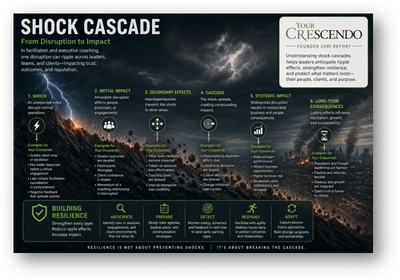
As Your Crescendo continued to grow, founder Reggie Hammond wanted a clearer understanding of how cybersecurity, operational dependencies, and business risk could impact long-term growth.
Sentinel Ridge conducted a Structural Security Risk Index (SSRI™) assessment that identified key areas of exposure, evaluated organizational resilience, and provided a prioritized roadmap for strengthening security, governance, and operational readiness.
The result was greater visibility into business risk, increased decision confidence, and a clearer path toward long-term resilience.
"The Sentinel Ridge assessment was thoughtful, useful, and directionally very strong. What stood out most was its ability to translate cybersecurity into structural business resilience."
Reggie Hammond - Founder & CEO, Your Crescendo